Research
2023 Frontline Nurse Mental Health and Well-being Survey
For the 4th year, we gauged the mental health & well-being of our nursing workforce to support the people who make up the backbone of our healthcare system.

Introduction

For the fourth year in a row, the team at Trusted Health has set out to gauge the mental health and well-being of our nursing workforce as part of our overall mission to support the individuals who make up the backbone of our healthcare system.
This year’s data offers reason for measured optimism. Nurses’ self-reported mental health ratings continued to improve since the darkest days of the pandemic, and the incidence of negative outcomes associated with mental health declined across every category year over year, with notable improvements in the prevalence of moral injury, compassion fatigue and suicidal thoughts.
Still, nurses don’t think that their facilities or the industry at large prioritize and offer adequate support for their mental health. Every year since we launched this survey, 95% of respondents have said that their mental health was either not a priority for the healthcare industry or that it was a priority, but that there were inadequate measures in place to support it. This year, more than half said that they had some level of dissatisfaction with the level of support their current facility provides. Notably, nurses who rated their overall mental health as positive were two and a half times more likely to be satisfied with the level of support their hospital provides relative to those who rated their mental health as negative.

The number of nurses who are planning to leave the profession within the next year dipped slightly from 2022, but still remains worryingly high. More than half of all nurses say that they are either actively looking for a job away from the bedside or outside of nursing completely, had plans to do so within the next year or were planning to retire from the workforce entirely.
Taken together, there are some encouraging signs in this year’s findings, but we as an industry still have work to do in order to stem the tide of departures. We must pursue an evidence-based approach to offering benefits that support nurses’ mental health and overall well-being. We must provide more support to the new nurses who are taking on responsibilities earlier and earlier in their careers. We must train managers and free up their time to better support their direct reports. We must find solutions to chronic staffing shortages. In short, we must better support our nurses, who do so much to support us.
Methodology & Demographics
The data in this study is gathered from responses from more than 1,900 nurses to an online survey conducted by email in April of 2023.
Eighty-seven percent of respondents were female, 12% were male and 1% were either gender non-binary, other or preferred not to say.
The majority of respondents (72%) were under the age of 44. The top specialties were critical care (20%), acute care (19%) and surgical (19%).
WHAT IS YOUR GENDER?
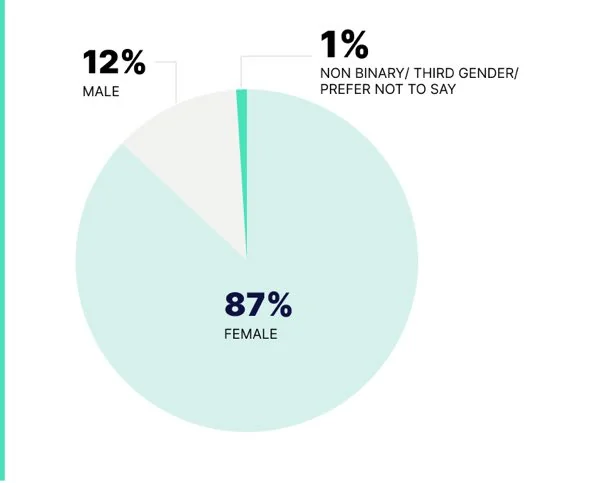 Chart data: 1% · 12% · NON BINARY/ THIRD GENDER/ · MALE · PREFER NOT TO SAY · 87% · FEMALE
WHAT IS YOUR AGE?
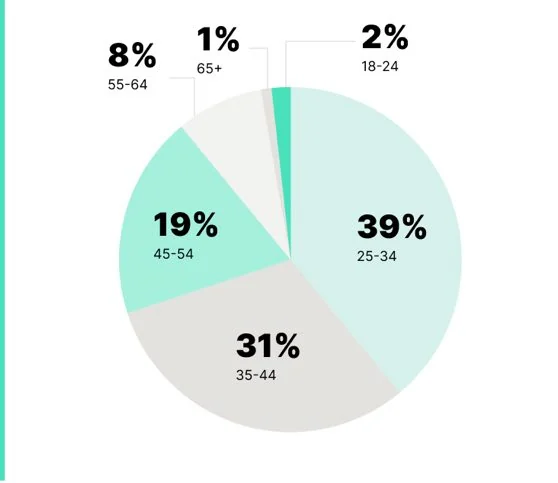 Chart data: 1% · 2% · 8% · 65+ · 18-24 · 55-64 · 19% · 39% · 45-54 · 25-34 · 31% · 35-44
WHAT IS YOUR CURRENT NURSING SPECIALTY?
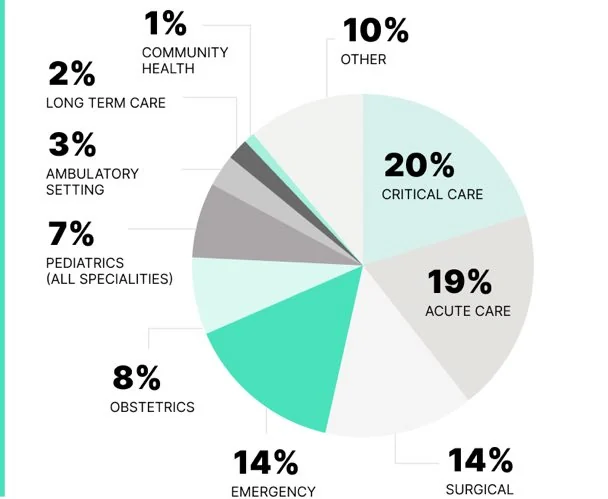 Chart data: 1% · 10% · COMMUNITY · OTHER · 2% · HEALTH · LONG TERM CARE · 3% · 20% · AMBULATORY · SETTING · CRITICAL CARE · 7% · PEDIATRICS · (ALL SPECIALITIES) · 19% · ACUTE CARE · 8% · OBSTETRICS · 14% · 14% · EMERGENCY · SURGICAL
HOW MANY YEARS HAVE YOU BEEN IN THE NURSING FIELD?
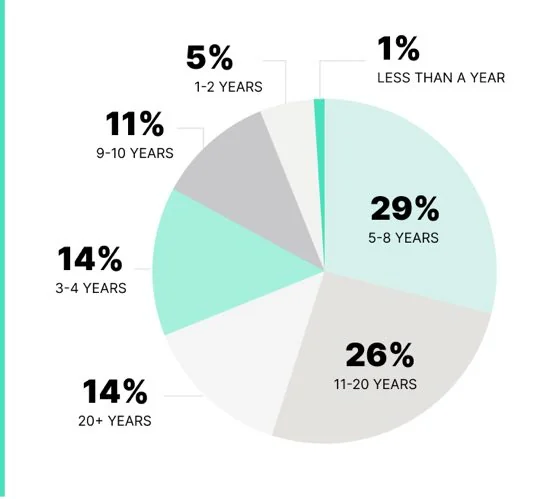 Chart data: 1% · 5% · LESS THAN A YEAR · 1-2 YEARS · 11% · 9-10 YEARS · 29% · 5-8 YEARS · 14% · 3-4 YEARS · 26% · 14% · 11-20 YEARS · 20+ YEARS
Key Findings
Nurses’ mental health has shown modest improvements each year since 2020.
Nurses’ mental health as self-rated on a scale of 1-10 has slowly ticked up each year since we started this survey during the early days of the pandemic.
The average rating for 2023 was 6.6, compared to an average of 5.8 in 2022, 5.7 in 2021 and 5.4 in 2020.
PLEASE RATE THE STATE OF YOUR MENTAL HEALTH AND WELL-BEING RIGHT NOW.
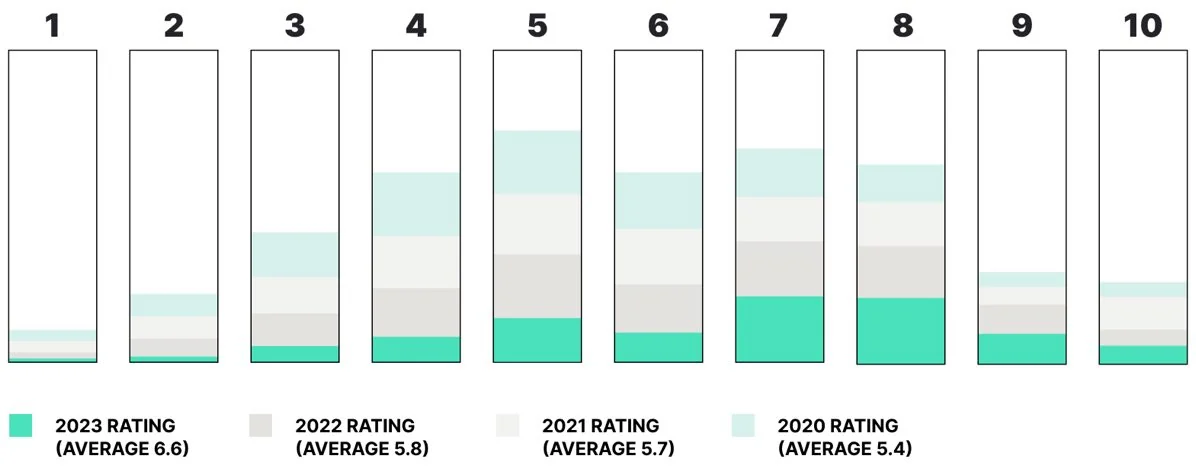 Chart data: 1 · 2 · 3 · 4 · 5 · 6 · 7 · 8 · 9 · 10 · 2023 RATING · 2022 RATING · 2021 RATING · 2020 RATING · (AVERAGE 6.6) · (AVERAGE 5.8) · (AVERAGE 5.7) · (AVERAGE 5.4)
WHICH OF THE FOLLOWING DESCRIBES YOUR OVERALL MENTAL HEALTH AND WELL-BEING?
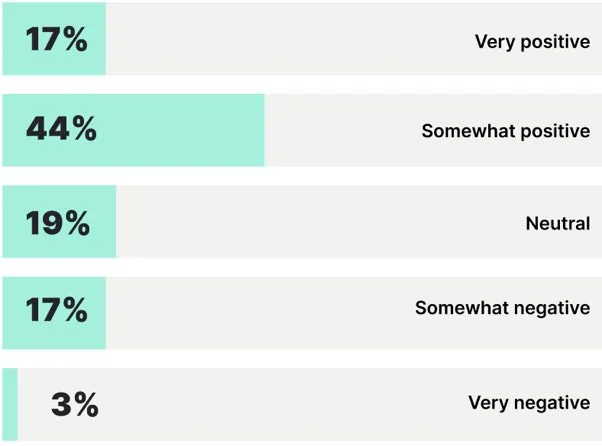 Chart data: 17% · Very positive · 44% · Somewhat positive · 19% · Neutral · 17% · Somewhat negative · 3% · Very negative
Negative outcomes associated with mental health have declined across every category over the last year.
While the incidence of things like burnout and depression is still worryingly high, we saw year-over-year improvements across every single category.
The biggest decreases were in moral injury (-28%), compassion fatigue (-27%) and suicidal thoughts (-25%). Taken with the findings in the previous section, this suggests that overall nurse mental health may continue to improve as COVID-19 further subsides.
EXPERIENCE
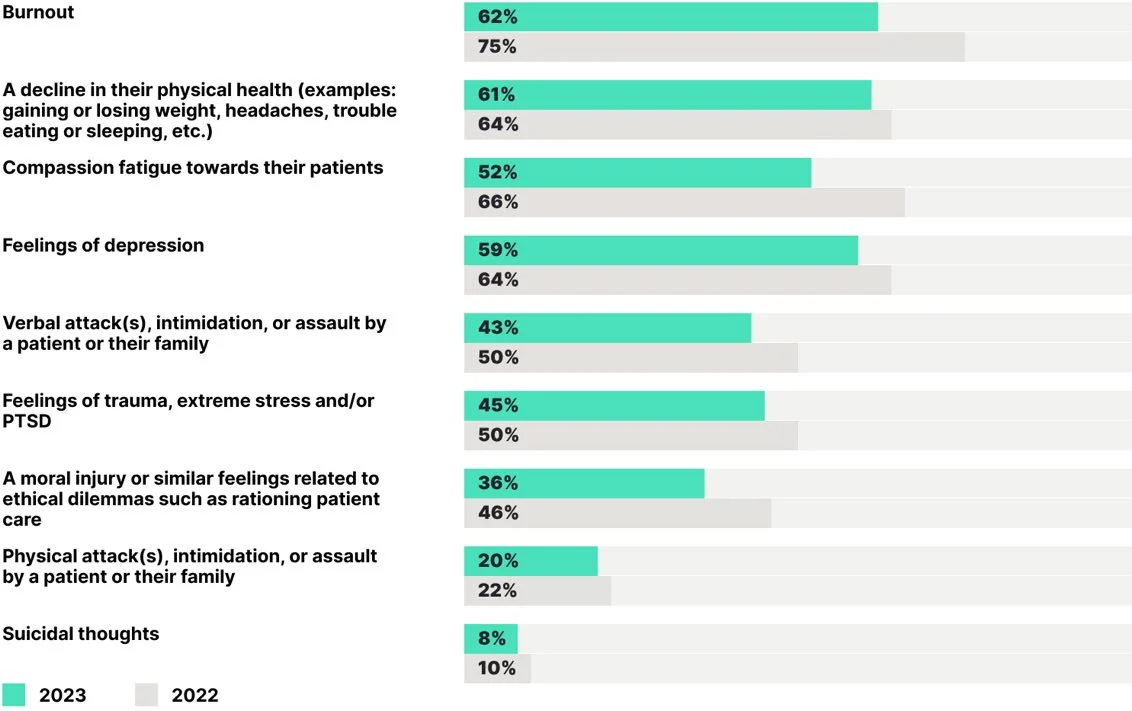 Chart data: Burnout · 62% · 75% · A decline in their physical health (examples: · 61% · gaining or losing weight, headaches, trouble · eating or sleeping, etc.) · 64% · Compassion fatigue towards their patients · 52% · 66% · Feelings of depression · 59% · 64% · Verbal attack(s), intimidation, or assault by · 43% · a patient or their family · 50% · Feelings of trauma, extreme stress and/or · 45% · PTSD · 50% · A moral injury or similar feelings related to · 36% · ethical dilemmas such as rationing patient · care · 46% · Physical attack(s), intimidation, or assault · 20% · by a patient or their family · 22% · Suicidal thoughts · 8% · 10% · 2023 · 2022

Staffing shortages top the list of things negatively impacting nurses’ mental health.
This year we dug into the specific variables that nurses said both positively and negatively impacted their mental health. Topping the list of positive impacts were pay and salary changes (39%), the atmosphere in a respondent’s unit or department (36%) and how prepared they felt to do their job (35%). The most-cited negative impacts included nurse staffing levels or shortages (80%), patient assignments (55%) and the atmosphere in a respondent’s unit or department (53%).Notably, nurses who graduated from nursing school pre-pandemic are twice as likely to say changes in institutional knowledge in the nursing field have had a negative impact on their mental health than nurses who graduated post-pandemic.
OVER THE PAST YEAR, HAVE ANY OF THE FOLLOWING COMMON NURSING EXPERIENCES AFFECTED YOUR MENTAL HEALTH?
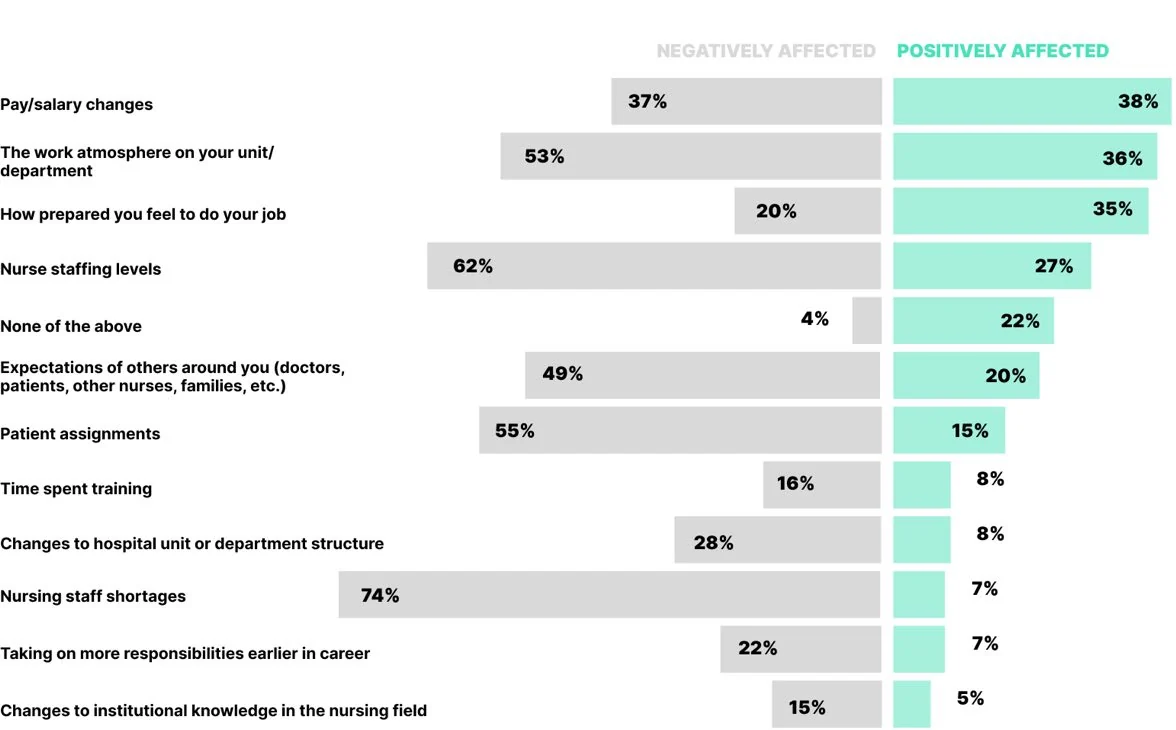 Chart data: NEGATIVELY AFFECTED · POSITIVELY AFFECTED · Pay/salary changes · 37% · 38% · The work atmosphere on your unit/ · 53% · 36% · department · How prepared you feel to do your job · 20% · 35% · Nurse staffing levels · 62% · 27% · None of the above · 4% · 22% · Expectations of others around you (doctors, · 49% · 20% · patients, other nurses, families, etc.) · Patient assignments · 55% · 15% · Time spent training · 16% · 8% · Changes to hospital unit or department structure · 28% · 8% · Nursing staff shortages · 74% · 7% · Taking on more responsibilities earlier in career · 22% · 7% · Changes to institutional knowledge in the nursing field · 15% · 5%
Nurses who reported that their mental health was positive are more than twice as likely to say they have a positive relationship with nurse leadership than those who reported negative mental health.
HOW DO EACH OF THE FOLLOWING GROUPS WITHIN YOUR HOSPITAL/ORGANIZATION AFFECT YOUR MENTAL HEALTH?
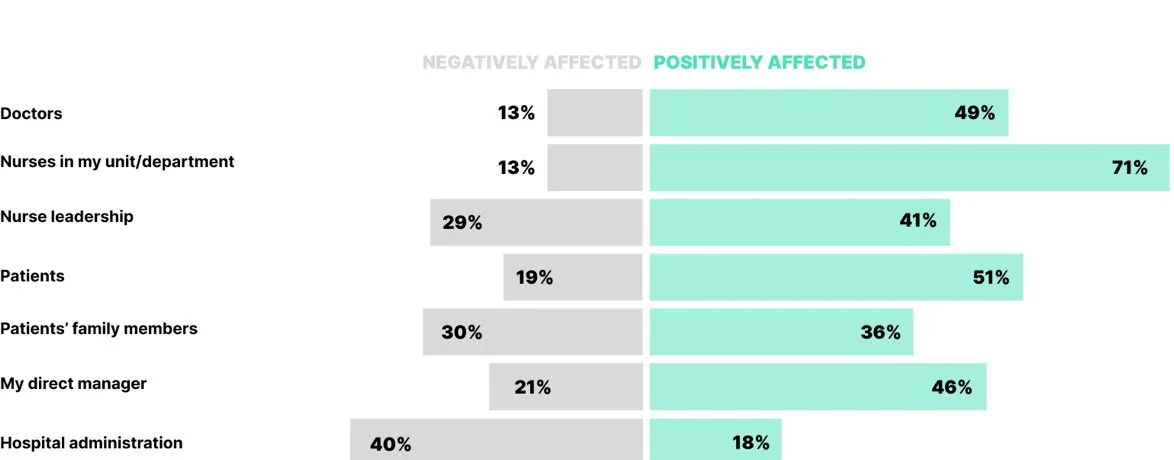 Chart data: NEGATIVELY AFFECTED POSITIVELY AFFECTED · Doctors · 13% · 49% · Nurses in my unit/department · 13% · 71% · Nurse leadership · 29% · 41% · Patients · 19% · 51% · Patients' family members · 30% · 36% · My direct manager · 21% · 46% · Hospital administration · 40% · 18%
Nurse dissatisfaction with support for their mental health and well-being at both the facility and the industry level remains high.
Consistent with our previous surveys, the vast majority of nurses feel unsupported at the systemic level when it comes to their mental health and dissatisfied with the offerings at their facility. For the fourth year in a row, 95% of respondents said that their mental health was either not a priority for the healthcare industry or that it was a priority, but that there were inadequate measures in place to support it.
HOW WELL DO YOU THINK THE HEALTHCARE INDUSTRY OVERALL PRIORITIZES AND SUPPORTS NURSES' MENTAL HEALTH AND WELL-BEING?

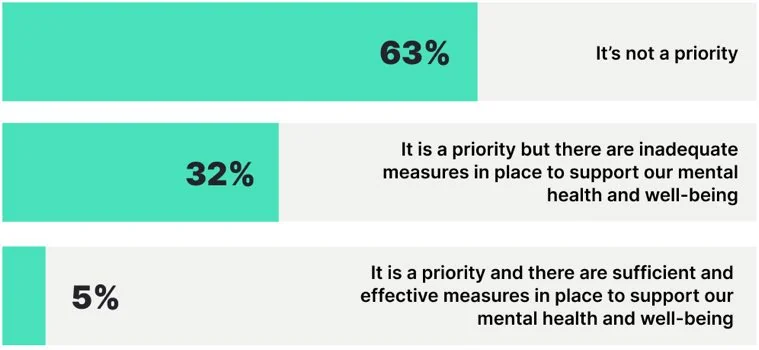 Chart data: 63% · It's not a priority · It is a priority but there are inadequate · 32% · measures in place to support our mental · health and well-being · It is a priority and there are sufficient and · 5% · effective measures in place to support our · mental health and well-being
HOW SATISFIED ARE YOU WITH THE LEVEL OF SUPPORT YOUR HOSPITAL/ORGANIZATION PROVIDES RELATED TO YOUR PERSONAL MENTAL HEALTH AND WELL-BEING?
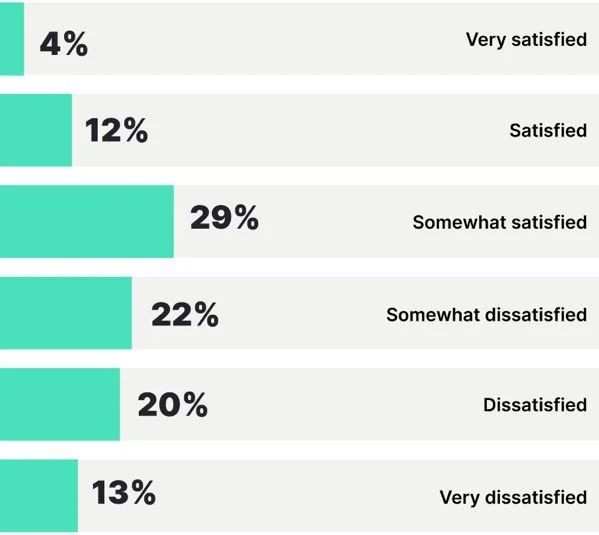 Chart data: 4% · Very satisfied · 12% · Satisfied · 29% · Somewhat satisfied · 22% · Somewhat dissatisfied · 20% · Dissatisfied · 13% · Very dissatisfied
Fifty-five percent of respondents ranked themselves either “somewhat dissatisfied,” “dissatisfied” or “very dissatisfied” with the level of support their current facility provides, a slight increase from 2022. Nurses who rated their overall mental health as positive were two and a half times more likely to be satisfied with the level of support their hospital provides relative to those who rated their mental health as negative.
Peer support programs have a significant positive impact on nurse mental health.
This year we looked at the relationship between nurses’ self-reported mental health with the dedicated mental health benefits and programs that their facilities offer, as well as general workplace initiatives in order to better understand their impact. We found the strongest correlation with peer support programs: nurses who report positive overall mental health are twice as likely to work at a hospital with a peer support program compared to those who rated their mental health as negative. Notably, nurses who report overall negative mental health are almost twice as likely (92%) to say their hospital doesn’t offer any benefits at all.
WHICH OF THE FOLLOWING MENTAL HEALTH AND WELL-BEING BENEFITS DOES YOUR CURRENT HOSPITAL/ORGANIZATION OFFER?
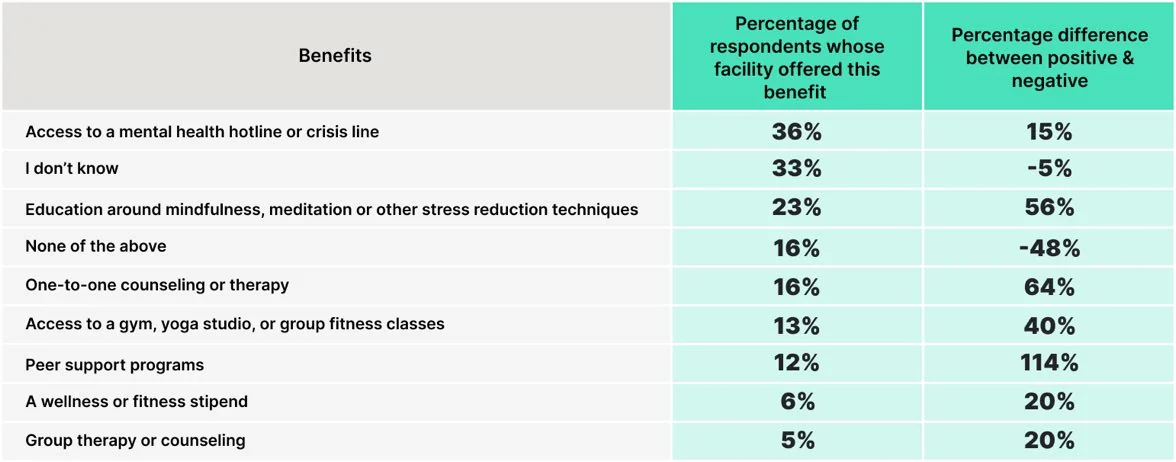 Chart data: Percentage of · Percentage difference · respondents whose · Benefits · between positive & · facility offered this · negative · benefit · Access to a mental health hotline or crisis line · 36% · 15% · I don't know · 33% · -5% · Education around mindfulness, meditation or other stress reduction techniques · 23% · 56% · None of the above · 16% · -48% · One-to-one counseling or therapy · 16% · 64% · Access to a gym, yoga studio, or group fitness classes · 13% · 40% · Peer support programs · 12% · 114% · A wellness or fitness stipend · 6% · 20% · Group therapy or counseling · 5% · 20%
WHICH OF THE FOLLOWING WORKPLACE BENEFITS DOES YOUR HOSPITAL OFFER?
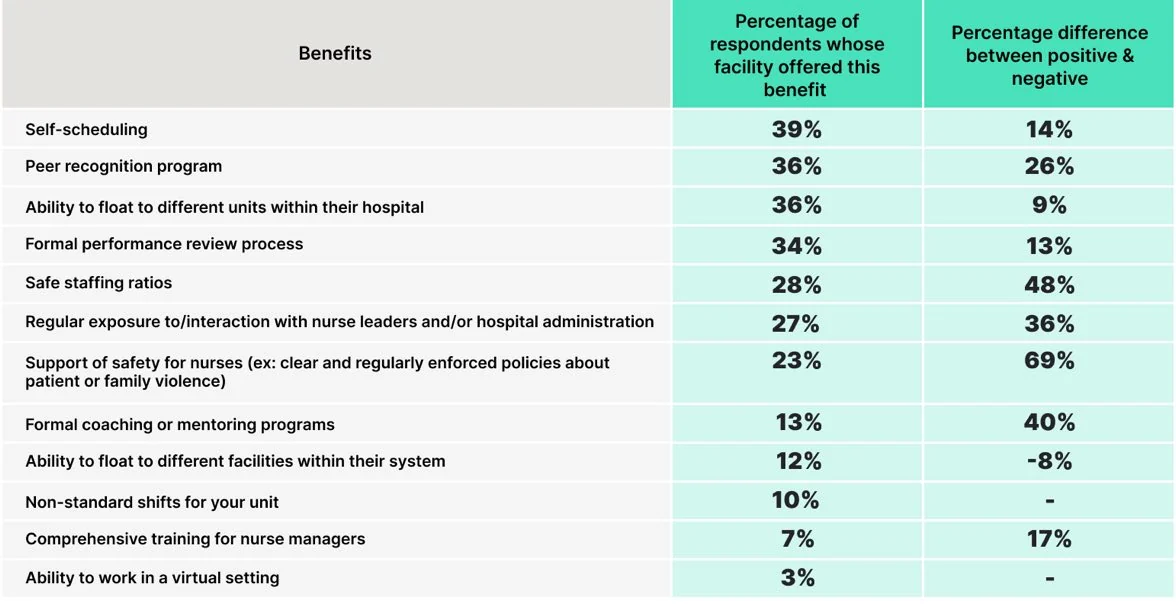 Chart data: Percentage of · Percentage difference · Benefits · respondents whose · between positive & · facility offered this · negative · benefit · Self-scheduling · 39% · 14% · Peer recognition program · 36% · 26% · Ability to float to different units within their hospital · 36% · 9% · Formal performance review process · 34% · 13% · Safe staffing ratios · 28% · 48% · Regular exposure to/interaction with nurse leaders and/or hospital administration · 27% · 36% · Support of safety for nurses (ex: clear and regularly enforced policies about · 23% · 69% · patient or family violence) · Formal coaching or mentoring programs · 13% · 40% · Ability to float to different facilities within their system · 12% · -8% · Non-standard shifts for your unit · 10% · - · Comprehensive training for nurse managers · 7% · 17% · Ability to work in a virtual setting · 3% · -
Seventy percent of nurses have never had their direct manager ask them about their mental health.
Just one in five nurses have been asked about their mental health in the last year, and just one in ten have been offered any kind of coaching or support.
Nurses have pursued a variety of measures – both healthy and unhealthy – to manage their mental health.
In the past year, one-third (33%) of nurses have personally sought care from a mental health professional such as a therapist, psychologist, psychiatrist or primary care provider. This figure rises to 51% when looking specifically at respondents who ranked their mental health as negative, indicating that nurses who are struggling are taking a more proactive approach to their mental health.
IN THE PAST YEAR, HAVE YOU PERSONALLY SOUGH CARE FROM A MENTAL HEALTH PROFESSIONAL SUCH AS A THERAPIST, PSYCHOLOGIST, OR PSYCHIATRIST?
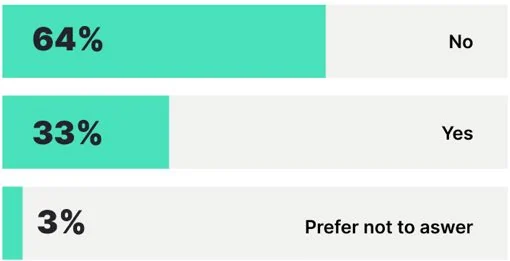 Chart data: 64% · No · 33% · Yes · 3% · Prefer not to answer
When asked about other actions that nurses have taken to manage their mental health in the past year, the top responses were largely positive: spending time in nature / going outside (64%), exercising, team sports or other physical activity (63%) and taking leave or an extended period of time away from their job (45%). However, more than a quarter of respondents said that they had increased their alcohol consumption or turned to recreational drugs. Moreover, nurses who reported that their mental health was negative were 77% more likely to be on prescription medication for depression or anxiety than those who reported that their mental health was positive.

IN THE PAST YEAR, WHICH OF THE FOLLOWING ACTIVITIES HAVE YOU ENGAGED IN AS A WAY OF COPING WITH OR MANAGING YOUR MENTAL HEALTH? SELECT ALL THAT APPLY.
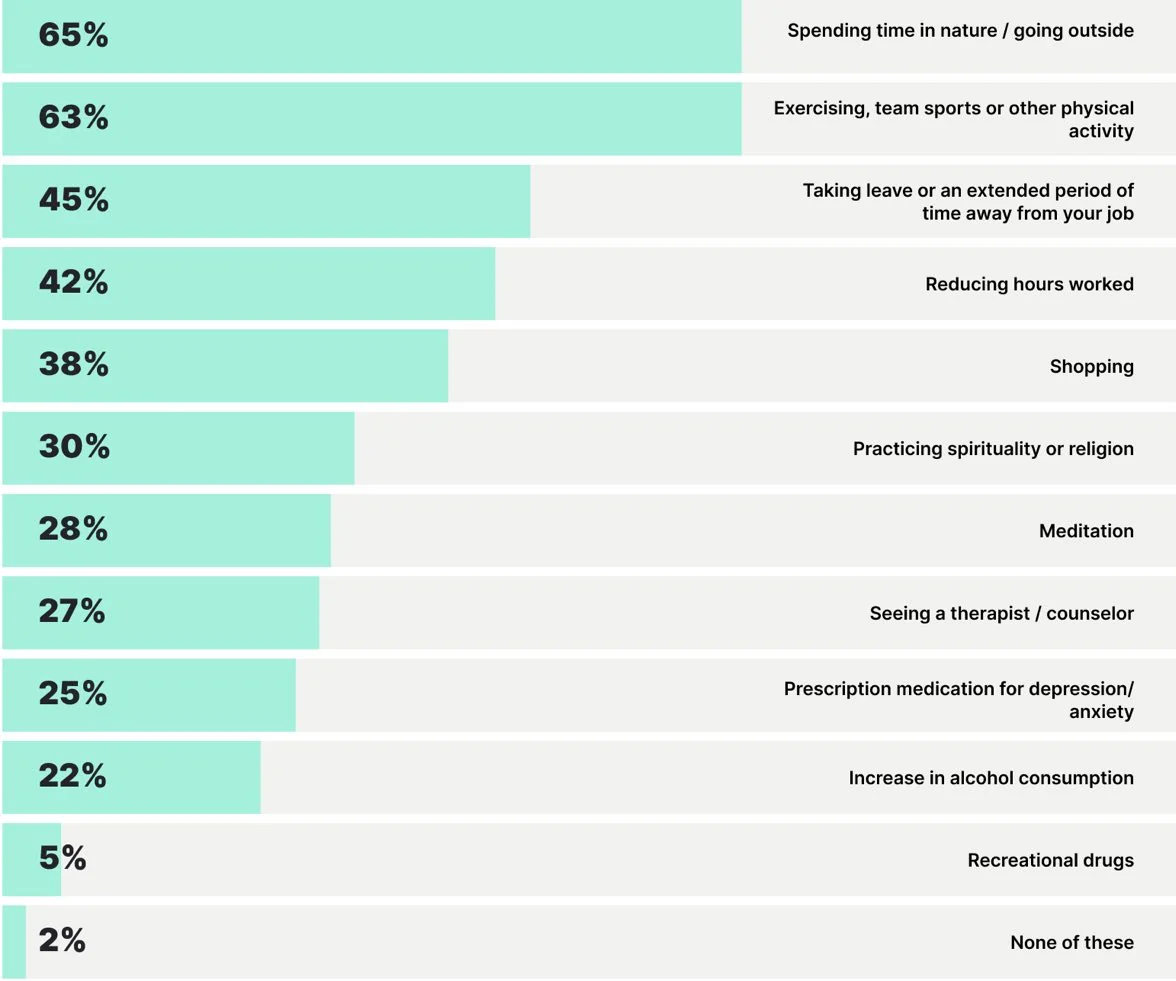 Chart data: 65% · Spending time in nature / going outside · 63% · Exercising, team sports or other physical · activity · 45% · Taking leave or an extended period of · time away from your job · 42% · Reducing hours worked · 38% · Shopping · 30% · Practicing spirituality or religion · 28% · Meditation · 27% · Seeing a therapist / counselor · 25% · Prescription medication for depression/ · anxiety · 22% · Increase in alcohol consumption · 5% · Recreational drugs · 2% · None of these
Nurses are taking on more responsibility earlier in their careers, and it’s having a negative impact on their mental health.
Nurses who graduated from nursing school post-pandemic are 61% more likely to have become a preceptor in their first year than those who graduated pre-pandemic. Similarly, almost a quarter (24%) of nurses who have ever been a charge nurse reported taking on that role less than one year into their career. Of those nurses who reported that they had taken on an advanced responsibility one year or less into their careers, 38% reported that it had had a negative impact on their mental health.
AT WHAT POINT IN YOU NURSING CAREER DID YOU FIRST TAKE ON EACH OF THE FOLLOWING RESPONSIBILITIES?
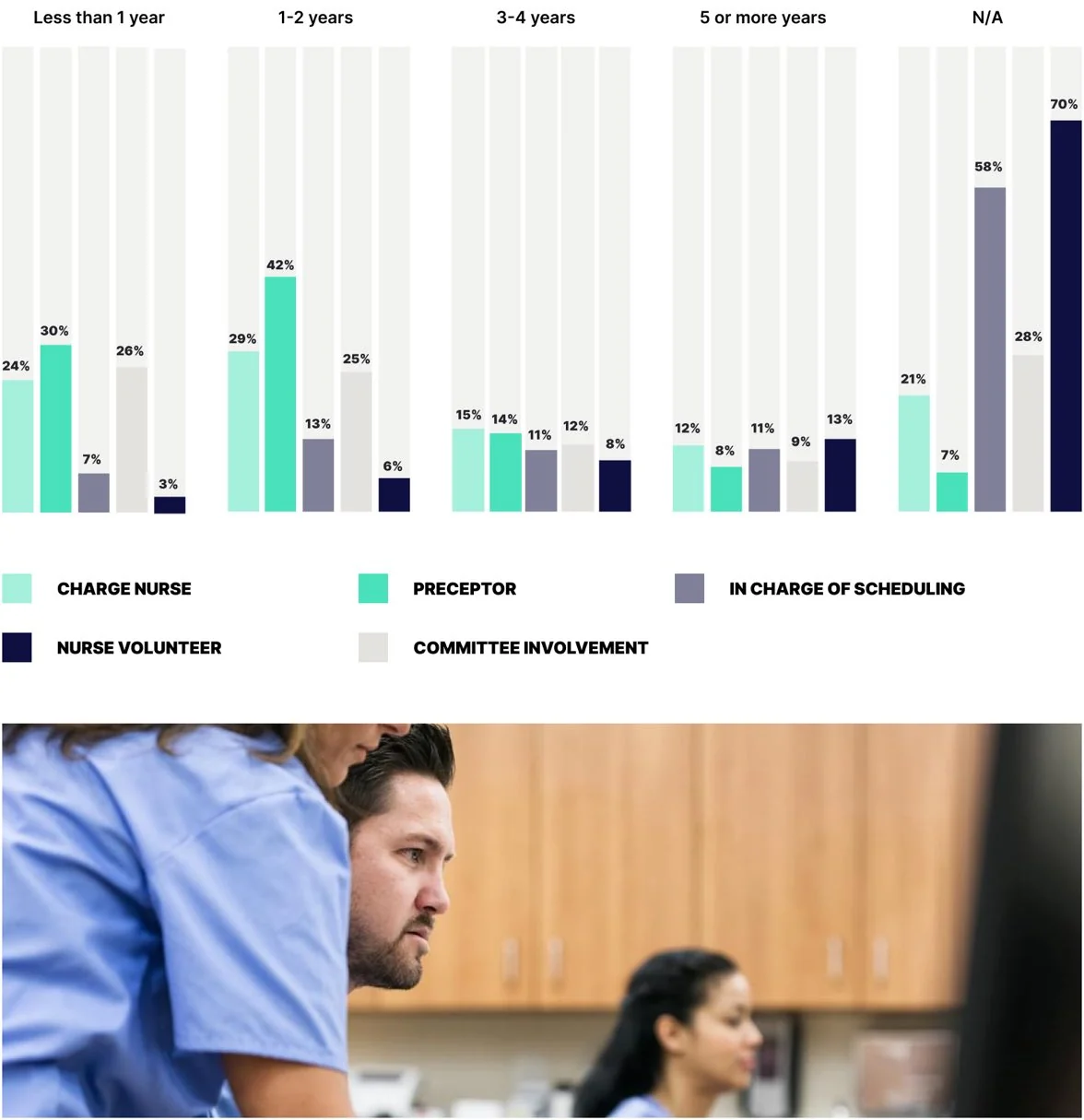 Chart data: Less than 1 year · 1-2 years · 3-4 years · 5 or more years · N/A · 70% · 58% · 42% · 30% · 26% · 29% · 28% · 24% · 25% · 21% · 13% · 15% 14% · 11% · 12% · 11% · 13% · 7% · 8% · 12% · 8% · 9% · 6% · 7% · 3% · CHARGE NURSE · PRECEPTOR · IN CHARGE OF SCHEDULING · NURSE VOLUNTEER · COMMITTEE INVOLVEMENT
The number of nurses who are planning to leave the profession within the next year dipped slightly, but still remains worryingly high.
When asked about their future career plans, 54% of all respondents reported that they were either actively looking for a job away from the bedside or outside of nursing completely, had plans to do so within the next year or were planning to retire from the workforce entirely. This was compared with 58% in 2022.
When we asked the nurses who were considering leaving the profession what the drivers were, the top reasons were feelings of underappreciation (60%), the job’s negative impact on their mental health (55%) and a desire to work from home or remotely (45%).
WHICH OF THE FOLLOWING BEST DESCRIBES YOUR FUTURE CAREER PLANS?
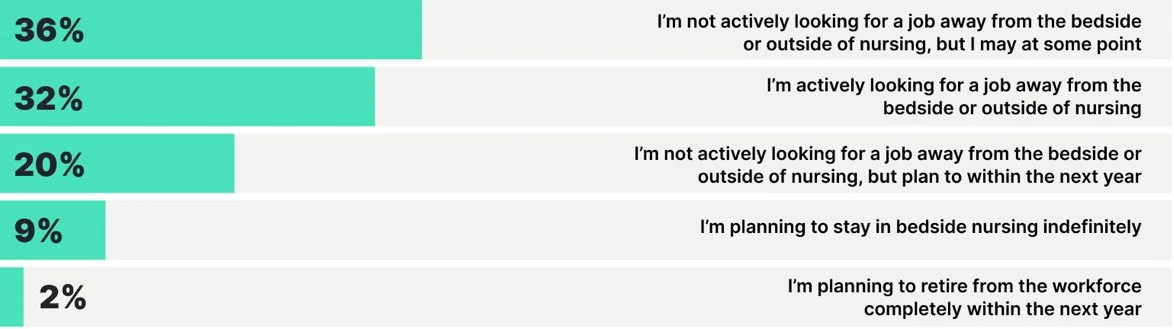 Chart data: I'm not actively looking for a job away from the bedside · 36% · or outside of nursing, but I may at some point · I'm actively looking for a job away from the · 32% · bedside or outside of nursing · I'm not actively looking for a job away from the bedside or · 20% · outside of nursing, but plan to within the next year · 9% · I'm planning to stay in bedside nursing indefinitely · I'm planning to retire from the workforce · 2% · completely within the next year
WHICH OF THE FOLLOWING ARE REASONS YOU ARE CONSIDERING LEAVING BEDSIDE NURSING OR NURSING AS A PROFESSION? SELECT ALL THAT APPLY:
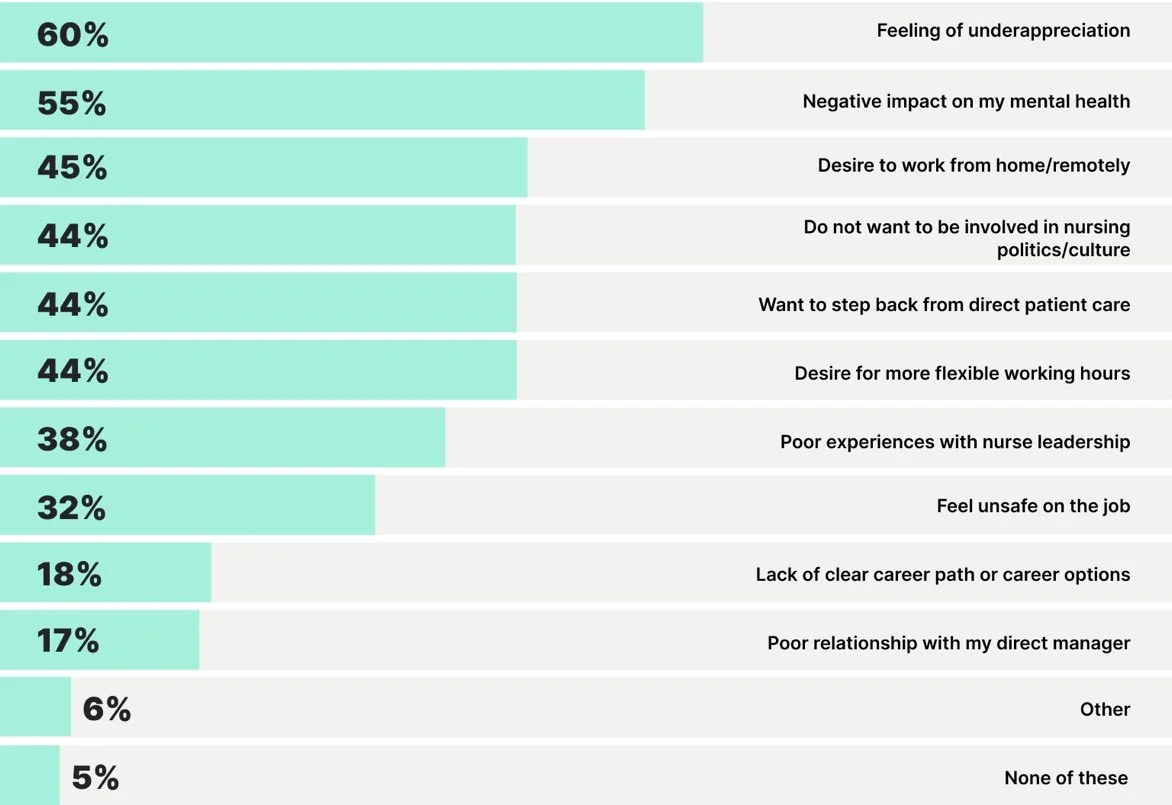 Chart data: 60% · Feeling of underappreciation · 55% · Negative impact on my mental health · 45% · Desire to work from home/remotely · 44% · Do not want to be involved in nursing · politics/culture · 44% · Want to step back from direct patient care · 44% · Desire for more flexible working hours · 38% · Poor experiences with nurse leadership · 32% · Feel unsafe on the job · 18% · Lack of clear career path or career options · 17% · Poor relationship with my direct manager · 6% · Other · 5% · None of these
Recommendations
Empower nurse managers to support their direct reports’ mental health.
One of the more dispiriting findings from this year’s survey is that the vast majority (70%) of all nurses have never had their direct manager ask them about their mental health, and just one in ten have been offered any kind of coaching or support. And yet, this isn’t surprising: studies have found that the average nurse manager has between 85-90 direct reports, creating a workload that leaves little time for non-transactional engagement or leadership. Nurse managers with a large team of direct reports should have the support of assistant nurse managers, educators, schedulers to help lessen the administrative burden of things like staffing and scheduling so they can focus on team building and development. Mental health support should also be a key component of training for nurse managers, with modules dedicated to recognizing signs of mental distress or crisis, and making mental health a part of informal check-ins and formal reviews.
Evolve your approach to staffing.
We all know that staffing continues to be one of the biggest – if not the biggest – challenges facing the healthcare industry, and this year’s survey highlights its negative impact on nurse mental health. Much of the industry’s thinking about nurse staffing stagnated years ago, and hasn’t evolved in response to more widespread generational changes in attitudes about work. Millennial and Gen Z nurses want more flexibility and autonomy around their careers, and the ability to choose how they work. Health systems need to remove rigid rules around scheduling and traditional roles for work, and provide flexible offerings such as self-scheduling, different shift lengths, flexible benefit packages, and the option to work on a full-time, part-time or gig basis. Technology like Works that provides dynamic staffing technology can help health systems be more agile and meet nurses’ desire for flexibility, while still achieving cost-effective safe staffing to support the front-line. Most importantly, evaluating staffing practices and making operational changes will have a positive impact on nurses’ work experience and well being.
Do more to support new nurses with increased responsibilities.
Due to the vast number of nurses who have left the profession in the last few years, new nurses are being asked to take on additional responsibilities like being a charge nurse or a preceptor earlier and earlier in their careers. And for more than a third (38%), it’s having a negative impact on their mental health. Educational and mentorship support should be baked into training for nurses who are taking on new roles as managers or preceptors, and regular check-ins should be a core part of their experience for a minimum of six months. Moreover, these kinds of advanced responsibilities should always be voluntary, never forced upon nurses who aren’t ready or aren’t interested.
Final Thoughts
The journey to supporting nurse mental health is ongoing, but hopefully this year’s survey offers some encouragement, both in the form of data that shows we’re moving the needle, however slowly, and ideas for how to better support the profession. In addition to the recommendations listed above, the data points to specific, concrete initiatives that work: peer support programs, employee recognition programs, self-scheduling, and one-to-one counseling or therapy. Concerted focus and effort are required, but in the end, our nurses are worth it.